
For businesses operating in the field services and trades, a fleet of vehicles is often viewed as a background utility required to move technicians and tools from one job site to the next. Financial oversight for these assets typically centers on the most visible lines on the balance sheet: monthly lease payments, fuel receipts, and major repair bills.
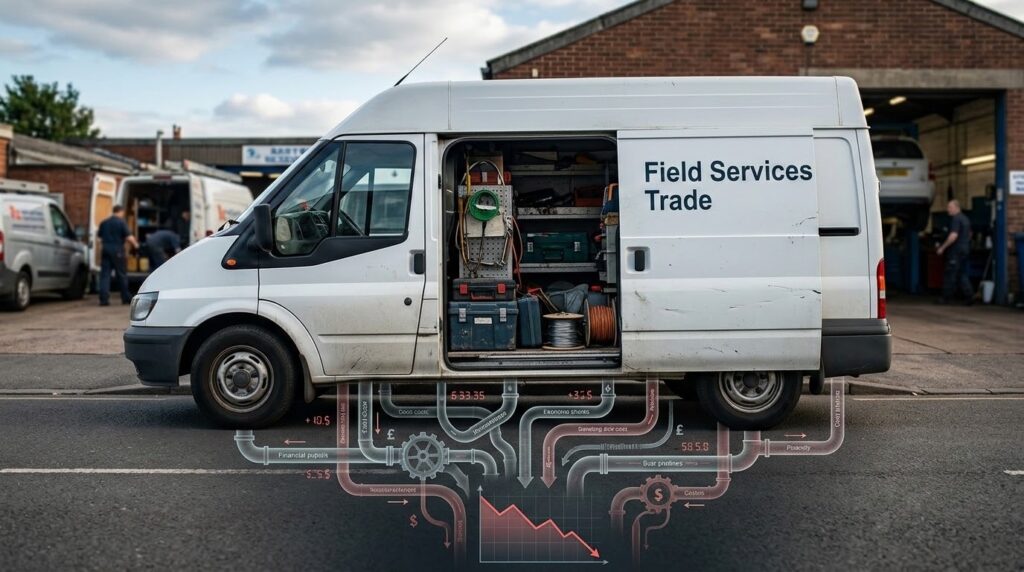
However, looking at fleet management through such a narrow lens obscures a more complex reality. The true financial burden of a field trade fleet rarely stems from these predictable, fixed expenses. Instead, profit margins are eroded by a compounding series of hidden inefficiencies, systemic operational gaps, and administrative bottlenecks. When vehicles are treated as mere background expenses rather than revenue-linked tools, organizations unwittingly allow profitability to bleed out through unmeasured downtime, chaotic routing, underutilized assets, and fragmented administrative workflows.
There Is No Such Thing as a Fixed Asset
A primary misstep in fleet financial management is categorizing vehicles as static operational costs. When a business views a van or truck merely as a mobile toolbox, the metrics used to judge its efficiency become fundamentally flawed.
In reality, every asset in a field trade fleet is a rolling service center with a direct link to the company’s revenue-generation potential. When a vehicle is stationary due to unexpected breakdowns, sitting idle in traffic due to poor planning, or underutilized because of scheduling imbalances, it actively drains capital. The cost is not just the price of the vehicle itself, but the lost opportunity cost of the revenue that the specific asset should have facilitated. Thus, to plug these silent financial leaks, businesses need to shift their mindset to view vehicles as revenue-linked tools.
E.g., unscheduled downtime is arguably the most destructive hidden variable in fleet operations. When a field trade vehicle suffers a catastrophic failure on the road, the immediate financial impact extends far beyond the towing fee and the mechanic’s invoice.
The true cost of downtime ripples across the entire operational ecosystem:
- Lost billable hours: A technician sitting on the side of a highway is not generating revenue, yet hourly wages must still be paid.
- Rescheduling chaos: Back-office staff must scramble to reassign jobs, displacing other scheduled clients and disrupting the flow of the entire workday.
- Customer dissatisfaction: Delayed arrivals or canceled appointments damage brand reputation, potentially leading to lost customer lifetime value and negative reviews that hinder future client acquisition.
To alleviate these compounding losses, reactive maintenance strategies must be replaced with structured oversight. Implementing systematic fleet maintenance and inspections ensures that wear and tear is identified and addressed before it manifests as an operational emergency.
Inefficient Routing and Underutilized Assets
Fuel consumption is a major line item for any fleet, but it is often managed as an inevitable cost of doing business. Many businesses assume that fuel expenses fluctuate solely based on macroeconomic oil prices. In truth, internal operational inefficiencies dictate that fuel spend far more than global markets do.
Without granular visibility into daily field operations, trade fleets frequently fall victim to structural micro-leaks, such as:
- Overlapping territories: Sending two different technicians to opposite ends of the same neighborhood on the same day due to fragmented scheduling.
- Excessive idling: Drivers leaving engines running to maintain cabin temperature or power tools, consuming fuel without advancing toward a job site.
- Circuitous route planning: Relying on drivers to navigate via personal intuition rather than optimized, real-time traffic data.
While a few extra miles driven or ten minutes of unnecessary idling per vehicle may seem negligible on a daily basis, these micro-leaks compound exponentially across a month or a year for an entire fleet. Utilizing a comprehensive guide for van tracking provides management with the analytical framework needed to identify these inefficiencies. Transitioning to data-driven routing ensures that assets travel the shortest, most efficient paths, directly lowering fuel expenditure, reducing vehicle wear, and maximizing the number of service calls a technician can complete within a standard shift.
Another quiet drain on profit margins is the presence of underutilized or redundant vehicles within the fleet. It is common for growing field trade businesses to acquire assets based on peak seasonal demand. However, maintaining a fleet sized for peak capacity means that during average or slow periods, expensive capital assets sit idle in a parking lot.
An idle vehicle continues to depreciate, incurs insurance premiums, and requires ongoing baseline maintenance, all while contributing zero dollars to the top line. Advanced fleet financial management requires a continuous audit of utilization rates. If specific vehicles consistently log low mileage or minimal billable hours, it signals a need to rebalance the fleet. Divesting from underutilized assets or shifting to a flexible, scalable fleet model frees up tied-up capital, allowing that cash to be redeployed into high-yield areas of the business, such as marketing or advanced technician training.
Administrative Bottlenecks and Cash Flow Constraints
The financial leaks associated with field trade fleets frequently extend deep into the back office. The operational velocity of a fleet must be matched by the velocity of the accounting processes supporting it. If administrative workflows are slow, paper-heavy, or fragmented, cash flow constricts, compounding the financial strain caused by physical fleet inefficiencies.
A significant point of friction occurs at the completion of a job. If a technician completes a field service but relies on physical paperwork to log hours, parts used, and client sign-offs, delays will inevitably occur. Paper invoices must be physically transported to the office, manually transcribed into accounting software, and then sent to the client. This extended administrative cycle artificially inflates Days Sales Outstanding (DSO) and delays cash inflows.
To maintain all financial processes efficiently, back-office workflows must embrace modern digital infrastructure. Implementing eSignatures for accounting allows technicians to secure immediate, legally binding client verifications right on the job site via mobile devices. This instant validation accelerates the billing cycle, transforming completed field work into active invoices within minutes rather than days.
Further out, when invoicing lags, client payment delays become more frequent. Thus, businesses need to establish clear, standardized protocols for accounts receivable to prevent outstanding balances from turning into bad debt. Having structured past-due invoice templates ready for deployment ensures that reminders are being sent systematically and professionally the moment an invoice crosses its due date. Combining digital signature capture with automated, precise collections workflows ensures that the revenue generated by the fleet is realized and deposited swiftly, stabilizing working capital.
Re-Contextualizing the Fleet
Everything considered, plugging the hidden leaks within a field trade fleet requires a cultural- and operational shift. Leaders need to move away from viewing vehicles as a burdensome overhead cost and begin treating them as precision-engineered revenue drivers.
When an organization successfully integrates disciplined maintenance schedules, optimized routing protocols, precise asset utilization metrics, and streamlined financial workflows, the fleet transforms into a formidable competitive advantage. Operating costs drop, technician productivity rises, and cash flow accelerates. In highly competitive trade markets, the businesses that master the internal financial and operational dynamics of their fleets are certain to secure sustainable, long-term profitability.