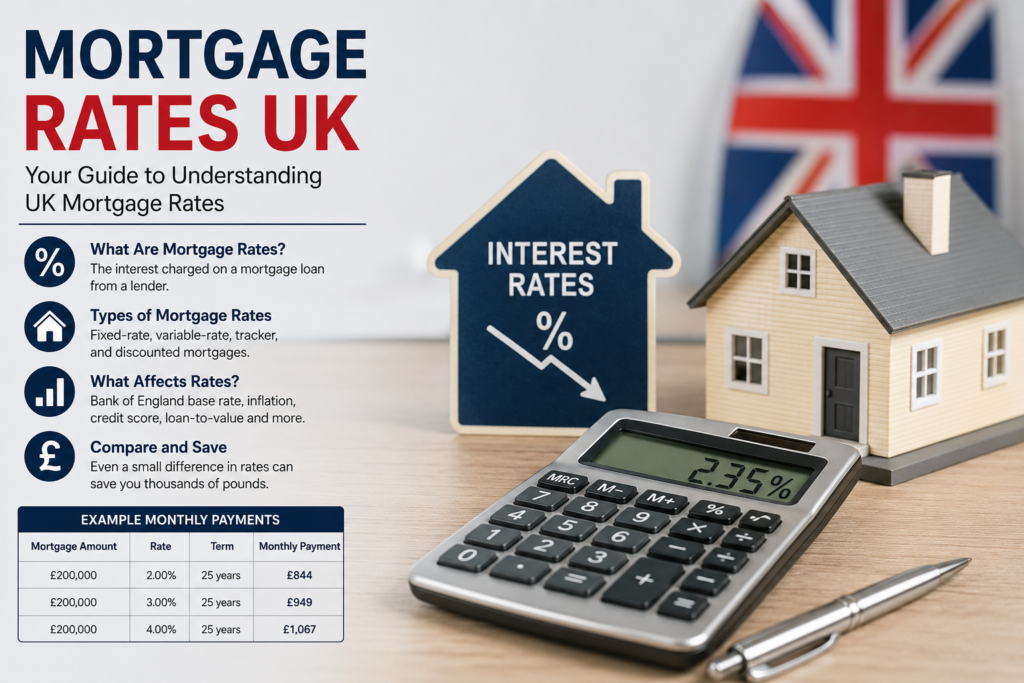

For anyone buying a home, remortgaging, or planning their finances, understanding mortgage rates UK is essential. Mortgage rates influence monthly repayments, borrowing affordability, and the overall cost of owning a property. Even a small difference in interest rates can add up to thousands of pounds over the life of a mortgage.
The UK mortgage market has experienced significant changes in recent years. Rising inflation, adjustments to the Bank of England base rate, and broader economic uncertainty have all affected borrowing costs. As a result, many homeowners are paying closer attention to interest rates than ever before.
Whether you’re a first-time buyer, moving home, or considering a remortgage, understanding how mortgage rates are determined can help you make more informed decisions.
Why Mortgage Rates Matter
A mortgage is usually the largest financial commitment most people will ever make. The interest rate attached to that loan determines how much you pay each month and how much interest you pay over time.
For example, a borrower taking out a £250,000 mortgage over 25 years will see a substantial difference in total repayment costs if the interest rate changes by just one or two percentage points.
Higher rates generally mean:
- Larger monthly repayments
- Reduced borrowing power
- Increased overall interest costs
Lower rates can make home ownership more affordable and may allow borrowers to qualify for larger loans.
Because of this, changes in the mortgage market often affect both the housing sector and the wider economy.
The Main Types of Mortgages Available in the UK
Not all mortgages work the same way. Different products suit different financial situations and risk preferences.
Fixed-Rate Mortgages
Fixed-rate mortgages remain one of the most popular choices in the UK.
With this option, the interest rate stays the same for a set period, commonly:
- Two years
- Three years
- Five years
- Ten years
This provides certainty because monthly repayments remain unchanged during the fixed period.
Many borrowers prefer fixed deals when interest rates are rising or when they want predictable household budgeting.
Variable-Rate Mortgages
Variable-rate mortgages can change over time.
The lender may increase or decrease the interest rate depending on market conditions and internal pricing decisions.
Repayments can therefore fluctuate, making budgeting less predictable.
Tracker Mortgages
Tracker mortgages follow an external benchmark, usually the Bank of England base rate.
For example, a tracker mortgage may charge:
- Base rate + 1%
If the base rate rises, repayments increase. If it falls, repayments decrease.
This type of mortgage can be attractive when rates are expected to decline but may become more expensive when rates rise.
Discount Mortgages
Discount mortgages offer a reduction on the lender’s standard variable rate for a fixed period.
Although often cheaper initially, repayments can still change if the lender adjusts its underlying variable rate.
What Influences Mortgage Rates in the UK?
Many people assume mortgage lenders simply choose rates at random. In reality, numerous factors influence pricing.
Bank of England Base Rate
The Bank of England’s base rate is one of the most important influences on mortgage pricing.
When the base rate increases, borrowing generally becomes more expensive for lenders, which can lead to higher mortgage rates.
Similarly, when the base rate falls, lenders may reduce mortgage pricing.
The relationship is not always immediate, but the base rate plays a major role in the overall direction of the market.
Inflation
Inflation affects the wider economy and often influences interest-rate decisions.
When inflation remains high, policymakers may keep interest rates elevated to slow spending and reduce price growth.
This can place upward pressure on mortgage costs.
Financial Markets
Mortgage pricing is also influenced by wholesale funding markets and investor expectations.
Lenders often use financial instruments and funding arrangements that reflect anticipated future interest rates.
As a result, mortgage rates sometimes move before official base-rate changes occur.
Competition Between Lenders
Competition remains an important factor.
Banks and building societies frequently adjust rates to attract borrowers.
A highly competitive market can lead to better deals even when broader economic conditions remain challenging.
Understanding Loan-to-Value (LTV)
One term that appears frequently in mortgage discussions is Loan-to-Value, commonly known as LTV.
LTV measures the size of the mortgage compared to the property’s value.
For example:
| Property Value | Deposit | Mortgage | LTV |
|---|---|---|---|
| £300,000 | £30,000 | £270,000 | 90% |
| £300,000 | £60,000 | £240,000 | 80% |
| £300,000 | £120,000 | £180,000 | 60% |
Lower LTV mortgages generally qualify for better rates because lenders face less risk.
Borrowers with larger deposits often have access to a wider range of mortgage products.
How Affordability Checks Affect Mortgage Offers
Modern mortgage lending involves detailed affordability assessments.
Lenders examine:
- Income
- Employment status
- Existing debts
- Credit history
- Regular spending patterns
They may also conduct stress tests to assess whether borrowers could still afford repayments if interest rates rise in the future.
This means that the cheapest advertised mortgage is not automatically available to every applicant.
Personal financial circumstances play a major role in determining eligibility.
First-Time Buyers and Mortgage Challenges
For first-time buyers, saving a deposit is often the biggest hurdle.
Property prices in many areas of the UK remain high relative to average earnings, making it difficult to accumulate sufficient savings.
A larger deposit generally leads to:
- Better mortgage rates
- Lower monthly repayments
- Greater lender choice
However, some lenders offer products designed specifically for first-time buyers, including higher LTV mortgages.
Government housing initiatives have also been introduced at various times to support home ownership, although availability and eligibility can change over time.
Prospective buyers should always verify the latest schemes before making decisions.
Remortgaging: Why Timing Matters
Many homeowners focus heavily on obtaining a mortgage but pay less attention when their initial deal ends.
This can be costly.
Once a fixed-rate or introductory period expires, borrowers often move onto a lender’s standard variable rate, which may be significantly higher.
Remortgaging allows homeowners to:
- Secure a new rate
- Reduce monthly payments
- Borrow additional funds if needed
- Change mortgage terms
Some borrowers begin researching options several months before their current deal ends to avoid paying higher rates unnecessarily.
Fixed or Variable: Which Is Better?
There is no universal answer.
The right choice depends on individual circumstances, financial goals, and risk tolerance.
A fixed-rate mortgage may suit borrowers who:
- Prefer predictable payments
- Have tight monthly budgets
- Want protection from future rate increases
A variable or tracker mortgage may appeal to borrowers who:
- Expect rates to fall
- Can tolerate payment fluctuations
- Want flexibility
Economic forecasts can be helpful, but no one can predict future interest rates with complete certainty.
Because of this, many borrowers choose certainty over speculation.
The Role of Credit Scores
Credit history can significantly affect mortgage options.
Lenders assess how borrowers have managed previous credit commitments.
Factors commonly considered include:
- Payment history
- Credit utilisation
- Outstanding debts
- County Court Judgments (CCJs)
- Bankruptcies
A strong credit profile can improve access to competitive mortgage products.
Those planning to apply for a mortgage may benefit from reviewing their credit records beforehand and correcting any inaccuracies.
Regional Property Markets and Borrowing Costs
Property prices vary considerably across the UK.
A buyer in London may require a much larger mortgage than someone purchasing a similar property in parts of Northern England, Wales, Scotland, or Northern Ireland.
Although mortgage rates themselves are not typically determined by region, local property values influence affordability and borrowing requirements.
This can affect the products available to different borrowers.
What Borrowers Should Watch in the Coming Years
Mortgage markets continue to evolve alongside economic conditions.
Future movements may depend on:
- Inflation trends
- Bank of England policy decisions
- Economic growth
- Employment levels
- Global financial developments
Predicting exact rate movements is impossible. Even professional economists regularly revise forecasts as new information emerges.
For borrowers, the most practical approach is often focusing on affordability rather than attempting to perfectly time the market.
A mortgage that remains comfortable during both favourable and challenging economic periods is usually a more sustainable choice.
Conclusion
Understanding mortgage rates UK is about more than simply finding the lowest advertised percentage. Interest rates influence affordability, long-term borrowing costs, and financial flexibility. Factors such as the Bank of England base rate, inflation, deposit size, credit history, and lender competition all play a role in shaping available deals.
Whether you’re purchasing your first home, moving property, or considering a remortgage, taking time to understand the mortgage market can help you make more confident decisions. While nobody can predict future interest-rate movements with certainty, choosing a mortgage that fits your financial circumstances remains the most important consideration.
FAQs
What is the difference between a fixed-rate and variable-rate mortgage?
A fixed-rate mortgage keeps the same interest rate for a set period, while a variable-rate mortgage can change over time.
Does the Bank of England base rate directly determine mortgage rates?
Not directly, but it strongly influences mortgage pricing across the UK market.
Can I remortgage before my fixed deal ends?
Yes, although early repayment charges may apply depending on your mortgage terms.
Do larger deposits help secure better mortgage rates?
In many cases, yes. Lower loan-to-value ratios often qualify for more competitive rates.
How often do mortgage rates change?
Mortgage rates can change frequently as lenders respond to economic conditions, funding costs, and market competition.