
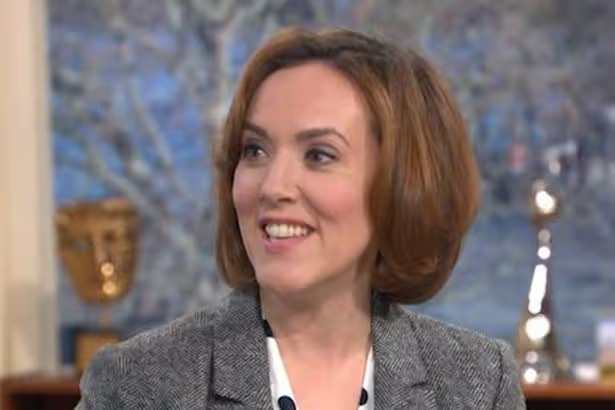

Camilla Tominey is a British journalist, broadcaster and commentator best known for reporting on the royal family and British politics. Her career began in local newspapers, but she gradually became a familiar figure in national media through high-profile royal exclusives, political columns, television appearances and radio presenting.
She currently works as an associate editor at The Telegraph, where she writes commentary and covers political and royal affairs. She also co-presents The Daily T podcast and hosts a Sunday morning political programme on GB News. Her direct interviewing style and strongly expressed opinions have earned her a substantial audience, although they have also made her a divisive figure in debates about the monarchy, Brexit and the British media.
Camilla Tominey at a glance
| Detail | Information |
|---|---|
| Profession | Journalist, broadcaster and commentator |
| Born | 14 June 1978 |
| Birthplace | Harpenden, Hertfordshire, England |
| Education | Law degree from the University of Leeds |
| Known for | Royal reporting, political commentary and television presenting |
| Newspaper role | Associate editor at The Telegraph |
| Broadcasting | Presenter on GB News and co-presenter of The Daily T |
| Previous publications | Hemel Hempstead Gazette and Sunday Express |
| Family | Married, with three children |
From a law degree to local journalism
Tominey grew up in Hertfordshire and attended St Albans High School for Girls. She later studied law at the University of Leeds. Although the degree provided useful training in research, evidence and careful interpretation, she did not pursue a conventional legal career.
Instead, she entered journalism through the local press. Her first significant newsroom position was a traineeship at the Hemel Hempstead Gazette. Local reporting can be an unforgiving introduction to the profession. Reporters are expected to cover council meetings, court cases, community disputes, accidents and human-interest stories, often within the same week. The work demands accuracy because journalists regularly encounter the people they write about.
Tominey qualified as a senior journalist while working at the paper. Her move into the national press came after she approached the Sunday Express and asked for shifts. That initiative led to a permanent opportunity and, eventually, a specialisation that would define much of her public career.
She did not initially set out to become a royal correspondent. The opportunity arose at the Sunday Express, where editor Martin Townsend asked her to work on royal stories. One of her first major assignments in that field was the 2005 wedding of the then Prince Charles and Camilla Parker Bowles.
The assignment placed her at the beginning of an important period for the modern monarchy. Prince William and Prince Harry were becoming prominent public figures, royal coverage was expanding internationally, and digital publishing was accelerating the speed at which palace news travelled.
How Camilla Tominey became a prominent royal reporter
Royal journalism operates differently from ordinary political reporting. The Royal Family rarely responds directly to every claim, while much of the useful information comes from private conversations with courtiers, friends, former staff members and other figures close to royal households. Reporters must assess the reliability and motivation of sources who may have only part of the story.
At the Sunday Express, Tominey advanced through a series of demanding positions. She served as royal editor and also took on political responsibilities, eventually working as political editor and a columnist. Covering both subjects made sense because the monarchy and government frequently intersect through constitutional duties, public funding, diplomacy and national ceremonies.
Her profile also grew outside Britain. She worked as a royal expert for NBC News and participated in American coverage of major events, including the wedding of Prince William and Catherine Middleton in 2011. She later covered the wedding of Prince Harry and Meghan Markle for the network.
The story most closely associated with her career appeared in October 2016, when she broke the news that Prince Harry was in a relationship with American actress Meghan Markle. The report attracted international attention before the relationship had been formally confirmed. It was subsequently nominated for Scoop of the Year at the British Press Awards.
That exclusive established Tominey as more than a television commentator invited to explain ceremonial events. It demonstrated that she had developed a network capable of producing original information about one of the world’s most closely watched families.
In 2018, she left the Sunday Express and joined The Telegraph as an associate editor covering politics and the royals. The move gave her a larger platform for news analysis and opinion writing at a time when the monarchy was facing growing tensions surrounding the Duke and Duchess of Sussex.
Politics, broadcasting and a more opinionated role
Tominey’s work increasingly moved beyond royal reporting. She became a regular commentator on television programmes discussing elections, Brexit, government policy and cultural issues. She has appeared on programmes such as the BBC’s Question Time and Politics Live, as well as ITV’s This Morning.
Her political outlook is generally regarded as right-of-centre. She supported Brexit and frequently writes from a conservative perspective, although her commentary does not always align neatly with a particular politician or party. She is willing to criticise Conservative figures as well as their opponents.
In 2021, she began presenting a Sunday afternoon programme on LBC. Call-in radio required a different set of skills from newspaper reporting. Instead of constructing an article from interviews and documents, a presenter must respond immediately to callers, challenge guests and keep a live discussion moving.
She left LBC before joining GB News, where The Camilla Tominey Show began in 2023. The Sunday programme combines interviews, newspaper discussion and political debate. Its scheduling places it in the competitive field of weekend political broadcasting, traditionally dominated by established public-service channels.
Alongside television, she co-presents The Telegraph’s The Daily T podcast with columnist and historian Tim Stanley. The programme examines current political and social stories through discussion rather than conventional straight-news reporting.
These roles are important when assessing her public work. A reported newspaper exclusive, a personal column and an opinion-led television discussion are different forms of journalism. Tominey moves between all three, which helps explain both her reach and the arguments surrounding her coverage.

Disputed royal stories and public criticism
Reporting about the Duke and Duchess of Sussex has brought Tominey particular scrutiny. One of the most debated stories concerned an emotional disagreement during preparations for Harry and Meghan’s wedding. Early reports suggested that Catherine, Princess of Wales, had been left in tears following a dispute about bridesmaid dresses.
During her 2021 interview with Oprah Winfrey, Meghan disputed that version and said the reverse had happened. She stated that Catherine had upset her but later apologised. Because the disagreement occurred privately and the people involved have not supplied a complete, mutually accepted account, outside observers cannot independently settle every detail.
The episode illustrates a broader weakness of royal reporting: stories based on confidential sources may be difficult for readers to verify. Supporters of Tominey argue that palace journalism depends on developing trusted contacts and reporting information that institutions would prefer to keep private. Critics contend that anonymous briefings can reproduce factional narratives without sufficient accountability.
Her outspoken political opinions have generated criticism as well. Some viewers appreciate her willingness to confront guests and state her position clearly. Others believe her presentation can blur the distinction between reporting and advocacy. The disagreement reflects a wider transformation in British broadcasting, where personality-driven analysis increasingly sits alongside traditional news coverage.
Tominey has also spoken about receiving threatening and abusive messages. Criticism of a journalist’s accuracy or arguments is legitimate, but personal threats are not an acceptable substitute for examining the evidence behind a report.
Family life and work with children affected by alcoholism
Tominey is married to Dominic Lincoln and has three children. The family has been associated with the St Albans area, although she generally keeps her children away from the centre of her public work.
One personal subject she has discussed openly is growing up with a mother affected by alcoholism. She has described the instability and emotional difficulty this created during her childhood. Rather than treating the experience only as a private biographical detail, she has used her platform to draw attention to children living in similar circumstances.
She became a patron of the National Association for Children of Alcoholics, commonly known as Nacoa. The charity provides information and confidential support to people affected by a parent’s drinking. Her involvement has included public speaking, journalism and participation in events designed to reduce the shame that often prevents families from seeking help.
This campaigning reveals a less confrontational side of her public profile. Much of the attention surrounding her concerns royal disputes or heated political interviews, but her advocacy is rooted in an issue with which she has direct personal experience.
Why her career attracts attention
Tominey’s career reflects major changes in modern journalism. She began in a local newsroom, built expertise through a national Sunday newspaper and then expanded into international television, talk radio, podcasts and opinion-led broadcasting.
Her continuing prominence comes partly from the range of subjects she covers. Royal affairs offer global recognition, while Westminster politics keeps her involved in everyday national debate. Her columns and programmes also give audiences a clear point of view rather than an attempt at complete personal neutrality.
That approach inevitably divides opinion. Yet it also explains why she remains visible in a crowded media environment. Readers do not encounter her solely as a royal historian or television host; they encounter a working journalist whose reporting, analysis and opinions frequently overlap.
Conclusion
Camilla Tominey has developed from a local newspaper trainee into one of Britain’s most recognisable royal and political commentators. Her report revealing Prince Harry’s relationship with Meghan Markle remains her best-known exclusive, but her career now extends far beyond palace coverage.
Through The Telegraph, GB News and podcasting, she has become part of the broader national conversation about politics, the monarchy and the press itself. Her work attracts loyalty and criticism in almost equal measure, making her a useful example of how modern journalists increasingly operate as reporters, interviewers and public personalities at the same time.
Frequently asked questions
Who is Camilla Tominey?
She is a British journalist, broadcaster and commentator who covers politics and the Royal Family. She works as an associate editor at The Telegraph and presents political programming on GB News.
Is she related to Queen Camilla?
No known family relationship exists between them. The shared first name sometimes causes confusion, particularly because Tominey began her royal-reporting career around the time of Charles and Camilla’s wedding.
What was her biggest royal scoop?
Her most widely recognised exclusive was the 2016 report revealing that Prince Harry was dating Meghan Markle. The story received a Scoop of the Year nomination at the British Press Awards.
What did she study at university?
She studied law at the University of Leeds. She subsequently chose journalism rather than entering a traditional legal profession.
Is she married?
Yes. She is married to Dominic Lincoln, and they have three children.
