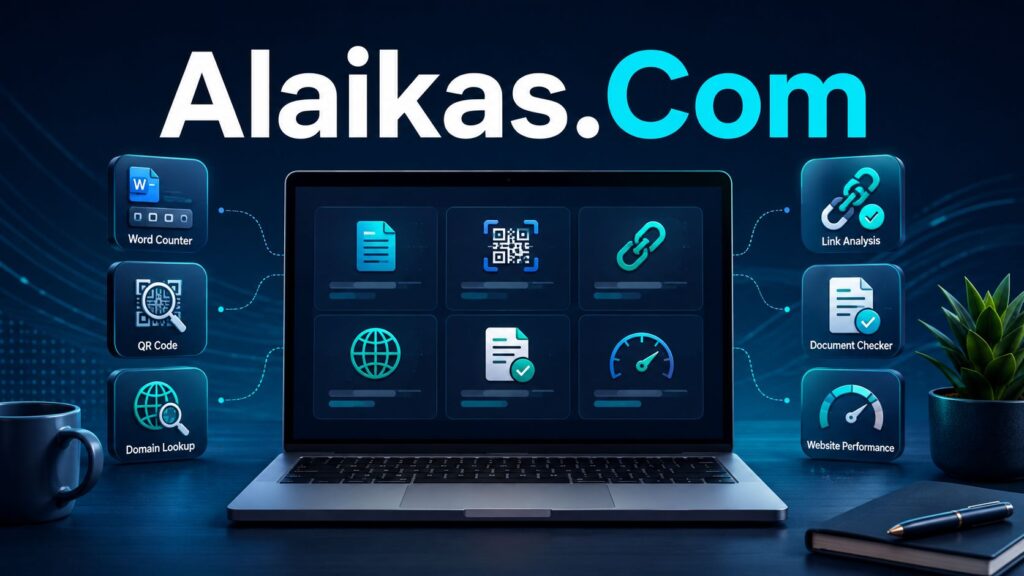

Alaikas.Com is a broad information website that combines general-interest articles with pages devoted to online utilities. A visitor may arrive looking for a word counter, domain checker, QR code decoder, or website-analysis resource, then discover articles covering technology, finance, property, digital assets, education, and everyday lifestyle topics.
That variety makes the platform difficult to describe in a single phrase. It is neither a traditional software service nor a narrowly focused publication. Instead, it operates as a mixed content hub: part practical reference library, part technology guide, and part general blog. Understanding that structure is important because the quality, purpose, and usefulness of one page may differ considerably from another.
What Is Alaikas.Com?
The clearest description is an informational platform built around online tools and explanatory content. Its main navigation includes a blog, contact page, privacy policy, and an introduction to the website. The homepage displays articles from numerous categories alongside older pages describing utilities for writers, website owners, marketers, developers, and researchers.
Among the resources presented on the site are a word counter, QR code decoder, keyword density checker, redirect checker, domain age checker, WHOIS lookup, backlink checker, IP locator, page-size checker, link analyzer, CPC calculator, sitemap generator, and policy generators. Some address very simple tasks, while others deal with technical website information.
However, there is an important distinction between a page that explains a tool and a working tool interface. Several pages examined provide instructions and describe expected functions, but the visible page content does not always clearly show the interactive form or input area needed to perform the task. Visitors should therefore confirm that a utility actually loads and produces results before depending on it.
Two Different Sides of the Website
The platform has two noticeable layers. The first consists of its original tool-related material. These pages are usually short and direct, explaining what a particular utility does, who might use it, and what kind of result it should provide.
The second layer is a much wider publishing operation. More recent material ranges across finance, home improvement, retail, property, cryptocurrency, health, technology, and business. This makes the website feel more like a general digital magazine than a dedicated collection of utilities.
The following breakdown helps clarify the difference:
| Area | Typical subjects | Likely audience |
|---|---|---|
| Writing resources | Word counting, rewriting, originality checks | Writers, students, editors |
| Website utilities | Redirects, links, page size, domains, IP addresses | Site owners and developers |
| Marketing calculations | Cost per click, keyword use, ranking information | Advertisers and publishers |
| General articles | Finance, property, technology, lifestyle and retail | Casual readers and researchers |
This mixture is not necessarily a problem. A broad publication can be useful when its categories are clearly organized and each article is carefully researched. The disadvantage is that readers cannot assume expertise in every subject simply because one part of the platform offers technical resources.
The Utility Pages Deserve a Closer Look
The tool-related section is likely to attract people who want quick answers without downloading software. A word counter, for example, is useful when checking an essay limit, preparing a social post, or editing a long article. The site’s word-counter page says the resource can measure words, characters, sentences, and paragraphs without requiring registration.
Likewise, a QR code decoder is intended to extract the address, text, contact information, or other data stored inside a QR image. This can be convenient when the code appears on another device or when someone wants to inspect its contents before opening the destination. The decoder guide describes an upload-and-decode process, although users should still inspect unfamiliar destinations before visiting them.
Domain and website-checking resources have more technical uses. A redirect checker may reveal where an address sends visitors, while a domain-to-IP utility attempts to identify the server address associated with a hostname. Page-size and link-analysis tools can help uncover heavy pages or broken navigation.
Results from these services should be treated as preliminary information rather than final proof. Domain records can be hidden by privacy services, servers may use several IP addresses, and backlink databases rarely contain every link on the internet. A single scan may also become outdated quickly.
The same caution applies to generators for privacy policies or terms and conditions. Generated text may provide a basic starting point, but it cannot automatically understand a company’s location, data practices, customers, payment arrangements, or legal responsibilities. A business handling sensitive information should have such documents reviewed for its actual circumstances.
What Kind of Articles Can Readers Find?
Beyond utilities, the main website publishes a large and varied collection of articles. Visible categories and recent posts include personal finance, real estate, home maintenance, retail displays, digital payments, technology, education, cryptocurrency, health, fashion, and social media.
This broad approach can help readers discover subjects they were not originally searching for. Someone checking a technical resource might notice an article about household maintenance or online payments. On the other hand, the wide editorial range makes source evaluation especially important.
A simple technology explainer and an article about financial decisions do not carry the same level of risk. General background information may be sufficient for learning basic terminology, but readers should verify legal, medical, financial, and investment claims with qualified or primary sources. Predictions involving markets or digital assets deserve particular caution because conditions can change rapidly and no publication can guarantee future prices.
There is also some online confusion about the identity of the domain. Certain third-party articles describe it as a fashion or general shopping store. The current official pages, however, primarily present articles and utility guides rather than a conventional retail catalogue with clearly visible products and checkout facilities. Claims that it is an established online retailer should not be repeated without direct, current evidence.
Is the Website Safe and Reliable?
Safety and reliability are separate questions. A secure connection can protect information travelling between a browser and a website, but it does not prove that every published statement is correct. Readers must evaluate both technical protection and editorial credibility.
The platform’s privacy policy says contact submissions may include a visitor’s name, email address, and message. It also states that limited technical information—such as IP address, browser, device, visited pages, and referring addresses—may be collected for performance, security, and analytics. Cookies and third-party advertising or analytics services may also be used.
These are common practices among advertising-supported publications, although privacy-conscious visitors may prefer to limit cookies through browser controls. People should avoid entering confidential business information, passwords, financial details, or private client data into an unfamiliar utility unless its processing and storage practices are clearly explained.
Reliability varies by page and subject. Useful signals include a named author, a clear explanation, realistic limitations, and information that can be checked elsewhere. Warning signs include absolute promises, unsupported claims of complete accuracy, vague sourcing, and statements that make a simple utility appear more powerful than it realistically can be.
For someone arriving at Alaikas.Com for a quick task, a sensible approach is to test the output with non-sensitive information. A word total can be checked in another editor. A redirect result can be compared with a browser inspection tool. Domain information can be confirmed through an established registry service. If two sources disagree, the result should be investigated rather than accepted automatically.
Who Is the Platform Most Useful For?
The site is best suited to casual researchers, bloggers, students, small website owners, and digital workers who need straightforward explanations of common online concepts. Its pages can introduce unfamiliar terms and point readers toward the type of utility required for a particular task.
Experienced developers or analysts may find the material too basic for detailed technical work. Similarly, companies making legal, security, or financial decisions should not use a short web guide as their only authority.
The strongest way to use the platform is as a starting point. Read the explanation, understand what the tool is designed to measure, test it with low-risk data, and verify important results independently. This turns a simple online resource into part of a more reliable research process.
A Practical Conclusion About Alaikas.Com
Alaikas.Com is a mixed informational website with a substantial collection of tool guides and a growing catalogue of general-interest articles. Its range is convenient, but that same breadth means readers should judge each page individually instead of treating the entire domain as equally authoritative.
The utility material may help explain everyday digital tasks, while the wider blog offers introductions to numerous subjects. Still, visitors should confirm that a described tool is operational, protect sensitive information, and independently verify any result that could affect a website, business, payment, legal document, or major personal decision.
Frequently Asked Questions
Is this primarily a shopping website?
The current official pages mainly show informational articles and online-tool guides. They do not clearly present the domain as a conventional fashion or retail store.
Are the online tools free?
Several tool pages describe their resources as free and say that registration is unnecessary. Availability should be checked directly because a descriptive page does not always confirm that the interactive function is currently working.
Can website-analysis results be trusted completely?
No single online checker should be treated as perfect. Domain, backlink, security, and performance results can be incomplete or outdated, so important findings should be confirmed through another reputable service.
Is it safe to paste private content into a tool?
Avoid submitting passwords, private client documents, unpublished business data, or personally identifying information unless the tool clearly explains how that data is processed and stored.
Does the platform provide professional legal or financial advice?
Its articles may offer general explanations, but they should not replace advice from a qualified professional who understands the reader’s circumstances and local rules.